Chapter 26: Of Ruins and Repairs
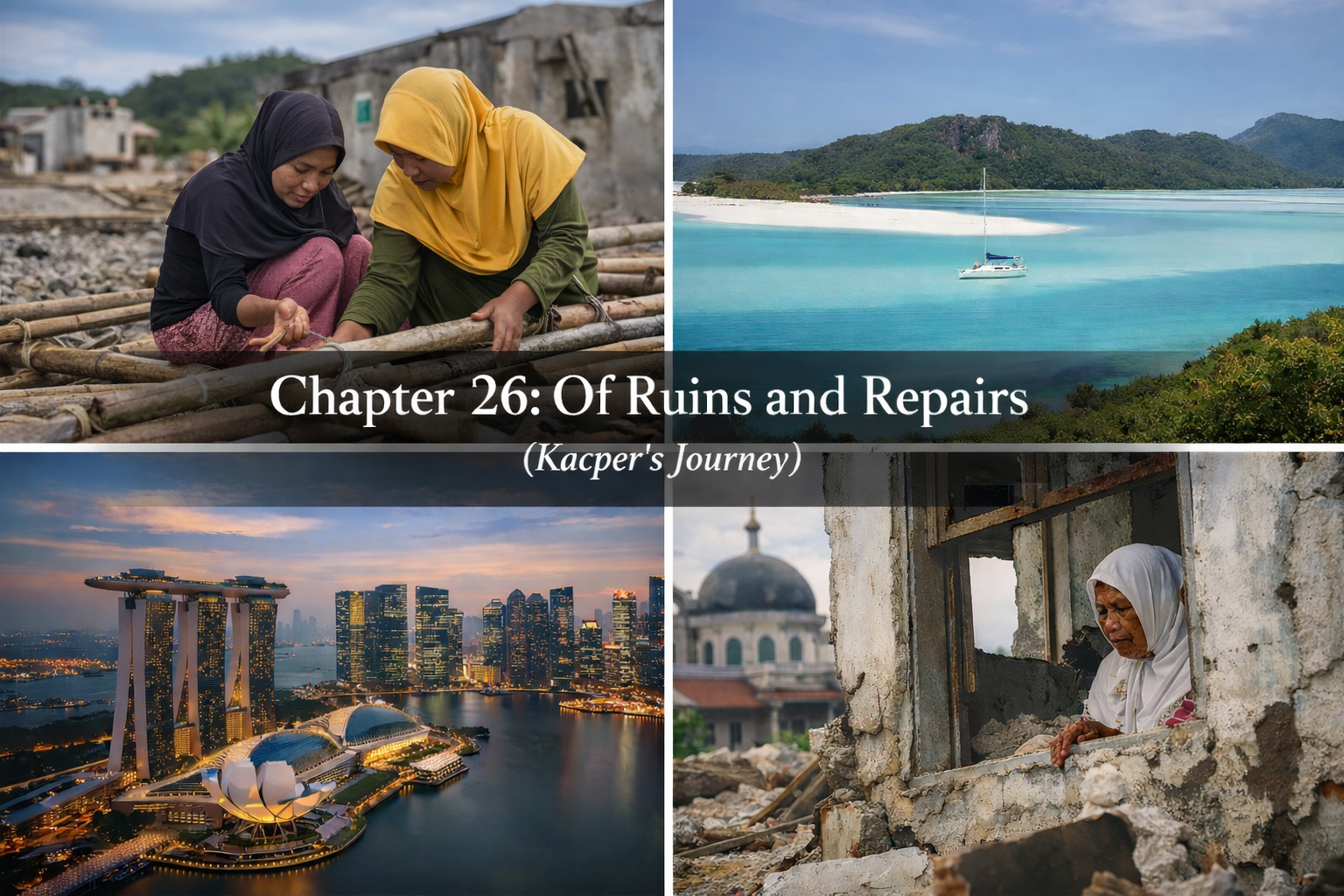
Chapter 26 is finally ready!
It takes place in Aceh, Indonesia — a region still marked by the devastating impact of the 2004 tsunami. What begins as a professional deployment quickly becomes something far more complex: a lesson in leadership, trust, and the slow, often uncomfortable nature of recovery.
When Kacper arrives, the project he is asked to lead is already struggling. Delays have accumulated, promises have not been met, and relationships with communities have deteriorated to the point where staff are hesitant to even return to the field.
“Donors were furious. Communities were losing patience. Promises had been made and broken.”
What appears at first glance to be a problem of performance reveals itself, over time, to be something deeper: a system paralysed by pressure, miscommunication, and loss of confidence.
Rather than imposing quick solutions, Kacper begins by listening.
“I’m here to understand.”
To his team.
To communities.
To the silences between what is said and what is avoided.
Slowly, a different approach emerges — one based on honesty, shared responsibility, and a willingness to accept limitations rather than promise what cannot be delivered.
This part of the story is very close to my real experience. The photographs below come directly from that period, when I was working in Aceh and travelling across the region:
👉 https://photos.app.goo.gl/3bbgAyMGsRxcrZm1A
(Pictures from Aceh and other parts of Indonesia during the mission)
These images offer a glimpse of the landscapes, people, and daily realities that shaped this chapter — far beyond what words alone can capture.
At the heart of the chapter are the people Kacper meets. Colleagues who carry their own stories, strengths, and vulnerabilities.
Among them, Rizal’s journey stands out — a young Acehnese colleague navigating personal identity in a context where being himself carries real risks.
“For the first time… I think I am not afraid.”
His story becomes one of quiet courage and transformation, supported by the solidarity of those around him.
Aceh itself reveals a series of contrasts. Deep generosity and warmth coexist with strict social norms and the application of Sharia law. It is a place where kindness and constraint exist side by side, and where understanding requires patience rather than judgement.
The chapter then opens outward, following Kacper beyond Indonesia.
During this time, travel became not only a logistical necessity, but also a space for reflection.
A short stop in Kuala Lumpur:
👉 https://photos.app.goo.gl/FHq767PKCgxe41mQ9
(A day in Kuala Lumpur on the way to London)
Moments in Singapore:
👉 https://photos.app.goo.gl/cXapLHZuwRwtaJm57
(Singapore, on the way to Australia)
In Singapore, Kacper reflects on something that stays with him:
“A city that became a country. A country that behaved like a carefully run city.”
These journeys offered contrast — between order and chaos, between different forms of development, and between the many ways societies organise themselves.
The narrative then moves further, into Australia — a place that had long existed in Kacper’s imagination.
👉 https://photos.app.goo.gl/s4gALe21PNMNUEbq6
(Queensland: Brisbane and the Whitsundays)
This part of the chapter carries a different energy. Friendship, rest, openness. Time spent with people who had once shared difficult humanitarian contexts, now building a different kind of life.
Yet even here, the story does not become simple. Encounters with inequality — particularly affecting Aboriginal communities — serve as a reminder that no society is free from injustice.
“Prosperity rarely erased history.”
The balance is broken when Kacper receives news that his mother has been hospitalised.
The story shifts again.
From professional responsibility to personal fear.
From distance to urgency.
Waiting becomes its own kind of test.
“Waiting. It sounded simple. It never was.”
The return home to Poland becomes a moment of grounding — a reminder of what truly matters, and how fragile everything can be.
Back in Aceh, the final days are marked not by closure, but by continuity.
The project is not “fixed.”
But it is no longer broken in the same way.
The team has regained confidence.
Relationships have been restored.
Something has shifted.
The farewell is not formal. It is human. A gathering organised by the team, where a traditional Saman dance — precise, rhythmic, collective — becomes a powerful symbol of what has been rebuilt.
“This, he thought, is what we tried to do.”
Trust.
Coordination.
Shared purpose.
“Of Ruins and Repairs” is not a story about success.
It is a story about presence.
“Recovery… was not about fixing what was broken. It was about staying present long enough for repair to become possible.”
About staying long enough. Listening carefully enough. Trusting enough for something new to begin to emerge from what once seemed irreparably broken.
And perhaps most importantly — it is a reminder that repair is never complete.
“It would continue, carried by others.”
A note
All the photo albums linked above are from my own life during the time that inspired this chapter.
While the book follows Kacper, these images reflect the real places, journeys, and moments that shaped his story.
🌍 Chapter 25: The World, Again

I have just finished Chapter 25 of my memoir, The World, Again — a chapter that follows the slow, careful return to life after a season of breaking and mending.
It opens before dawn in Biegonice, in the quiet intimacy of my parents’ kitchen. Tea. Bread. The gentle movement of my mother in the half-dark. A conversation that unfolds without effort, as if time and distance had never intervened. There is laughter, memory, worry, tenderness — and the grounding relief of being fully seen without having to explain oneself.
From that table, the story begins to widen.
There is a winter drive to Košice, where the city lies hushed beneath frost, where wool is bought for future jumpers, where hands are wrapped around hot chocolate in a café, and where the possibility of change is spoken aloud for the first time. Soon after comes the email from CrossWorld, confirming a new role and opening a door that had not yet existed in Kacper’s imagination.
The chapter then carries him outward across continents and emotional landscapes:
to Cape Town, where ocean and mountain restore a sense of scale and belonging;
back to Nairobi, where reunions with his team bring tears, laughter, gratitude, and the deep reassurance of shared survival;
on to New York, where past and future sit quietly together in the night;
and finally to Oxford, where a new professional life takes shape.
In Oxford, Kacper walks streets he once wandered as a young, uncertain boy from Poland, carrying little more than hope and fear. Now he walks them as a professional, calm and grounded, no longer shrinking from the world. His induction at CrossWorld introduces a language of humanitarian work that resonates deeply with his own history: poverty understood as injustice rather than misfortune; gender recognised as a force that shapes every life and opportunity; dignity treated as non-negotiable; partnership valued above charity. His childhood of scarcity and his years with GNI quietly echo through those conversations, giving the work both memory and meaning.
The chapter’s final movement carries him far from Europe, across oceans and histories, to Aceh, Indonesia, still rebuilding two years after the great tsunami. The arrival in Banda Aceh is filled with heat, salt, traffic, prayer, ruins, and renewal — the strange beauty of a city that has learned how to live beside its own loss.
It ends in a guest house that feels almost unreal — gold, chandeliers, fish tanks, pink bedding, earthquake briefings — and in the deep, dreamless sleep of someone who has finally arrived where he is needed.
The World, Again is about commitment.
Commitment to work.
Commitment to people.
Commitment to remaining open to life even after it has been frightening.
This chapter marks the moment when healing becomes movement, when memory becomes responsibility, when the world — slowly, quietly — opens itself again.
And Kacper steps forward.
🌿 Chapter 24 Completed: “The Season of Mending”

Some chapters are written with energy.
Some with urgency.
Some with memory.
And then there are chapters that arrive quietly, the way healing does.
I have just finished Chapter 24 of my memoir, “The Season of Mending.”
It may be the most tender chapter I have written so far.
This chapter follows Kacper at a moment when the world finally asks him to stop running.
After years of missions, wars, borders, airports, responsibilities, and carrying other people’s emergencies on his back, Kacper arrives in rural Scotland at a therapeutic retreat called Glenmarch House. The landscape receives him gently — mist, old pines, stone walls, frost, and long silences. Nothing dramatic happens there. And yet, everything begins to change.
“The Season of Mending” is not about heroism.
It is about permission.
Permission to rest.
Permission to feel small.
Permission to admit that even the strongest endurance has its limits.
At Glenmarch, Kacper meets Joy, a therapist whose calm presence and deep patience guide him through the slow work of facing himself. Their conversations do not begin with the recent crisis in Nairobi. They begin with the body. With childhood illness. With growing up in Poland under Martial Law. With shame, scarcity, survival, and the quiet architecture of his parents’ love.
From there the story widens — through London, Denmark, India, Iran, Canada, Iceland, Angola, Afghanistan, Sudan, and the long humanitarian road that shaped his adult life. The chapter becomes a kind of inner map of his entire journey, seen not through achievements but through the emotional costs of carrying too much for too long.
Alongside the therapy, life at Glenmarch unfolds with quiet beauty:
• long walks through frozen woods
• snowfall softening the world
• phone calls with his mother, full of ordinary love
• news of the birth of his niece Frania
• trips to Edinburgh and Glasgow
• shared laughter with Ilona and Mateusz, two young staff members who become unexpected companions on this fragile stretch of the road
One of the most important moments of the chapter comes when Kacper, encouraged by Joy, finally begins to tell his truth to people he loves. He writes to Helga in Iceland. He writes to Camila. Their responses — gentle, patient, unafraid — become the turning point. He is heard. And the world does not withdraw its affection.
By the time he leaves Scotland, five weeks later, nothing is “fixed.”
But something essential has shifted.
He boards a small Ryanair flight from Glasgow to Kraków, heading home to his family, to hold his niece for the first time, to re-enter the world not as a man repaired, but as a man no longer hiding.
This chapter is about the moment when endurance ends —
and repair begins.
It is about discovering that the world, even after everything,
is still wide enough to hold you.
Chapter 23: Learning to Breathe - Final Draft Ready

There are chapters in a life that do not unfold so much as rupture, and Chapter 23 sits precisely there — in the uneasy space between exhaustion and revelation, between quiet despair and the stubborn, surprising persistence of hope. It is a chapter rooted in Nairobi, though its shadows stretch far beyond it, reaching back into Fangak’s red mud and forward into a Scotland still unseen.
Kacper returns from South Sudan unsteady on his feet, carrying the weight of flooded villages, long nights in leaking huts, and the silent fatigue that follows too much witnessing. Nairobi, with its matatus zig-zagging through fumes, the cafés near Yaya Centre, and the stubborn resilience of everyday life, receives him with familiarity — but not with comfort. His body softens; his confidence thins. He laughs with colleagues, but never quite reaches the laughter itself.
Still, life resumes.
Work regains a rhythm.
The team takes shape around him.
Claire, all calm precision and quiet intelligence, offers a steadiness that makes the office feel less fragile. Nora, bright and expansive, sweeps fatigue from a room simply by entering it. And the newest arrival, Lina — multilingual, outrageous, brilliant — folds into the trio like a missing instrument.
Together they climb the Ngong Hills. They laugh into the wind. For the length of an afternoon, it feels possible to be light again.
But humanitarian normality is always provisional.
The first blow lands with El Wak.
Two Kenyan colleagues — men Kacper had known, laughed with, trusted — are killed on their way home, not on duty, simply living their ordinary day. The news reaches him through tears in Nora’s eyes. The world tilts. Kacper and Nora charter a small plane to the border, crossing the arid land with the hollow knowledge that nothing they do will ever be enough. They sit with mothers and brothers, drink bitter tea, listen to grief that has the texture of dust and age, and promise to remember.
And then — because the field never obeys a single emotional register — the chapter turns to the absurd and the ancient: the fifty cows.
A colleague in Old Fangak is arrested after a foolish mistake involving a married woman. The local commander demands compensation not in money, not in negotiation, but in cattle — the tall-horned river-country cows that carry prestige and pride. What follows is one of the strangest logistical operations of Kacper’s career: hiring a cattle expert, purchasing the right animals in Bor, and organising the perilous two-week march northwards through contested land.
It is farcical, frightening, and somehow beautiful in its own wild logic.
When the cows finally arrive, Commander Lual beams like a triumphant monarch and declares — to Kacper’s astonishment — that anyone is welcome to sleep with his wife so long as they bring equally fine cattle.
It is a moment both ridiculous and real, an anecdote Kacper will later tell with a mixture of disbelief and affection. But comedy does not erase cost. Once the laughter fades, a strange emptiness settles inside him.
And this is where the chapter deepens.
Loneliness — long denied — begins circling him more tightly. Shame grows quiet but sharp. The memory of Rio returns not as longing, but as guilt. He sees his reflection and flinches. Nights stretch. Thoughts acquire edges.
Slowly, softly, he begins imagining an end to his own story.
One evening, when Claire and Nora are out, he locks himself in the annex room. Vodka. Pills. Silence. A long spiral he cannot see his way out of.
By chance — or something that looks very much like grace — the two women turn back after a minor car accident. The guard insists Kacper is inside. They force the door open. The ambulance arrives. The night becomes a blur.
He wakes in Nairobi Hospital — and the chapter offers a quiet echo to long-time readers:
He knew these corridors from another fear, another year.
What follows is one of the most intimate passages in the book.
A Kenyan psychiatrist sits by his bed and simply refuses to leave until Kacper speaks. It takes three days. When words finally break through, they come as tears first, then as the truths he had carried for years — his longing, his shame, the belief that he was unlovable, the quiet ache he had never dared to articulate.
The doctor listens, without flinching, without judgement.
In a country he had feared might reject him, he finds unexpected tenderness — the first person on earth to whom he ever tells the full truth of himself.
It becomes the chapter’s most profound irony and its quiet redemption.
Marc arrives from New York, offering compassion rather than consequences, insisting that GNI stands with him. No punishment. No shame. Only care.
In the end, the decision is made: Kacper will go to a trauma centre in Scotland, a place dedicated to those who have seen too much and carried too heavy a load for too long. He boards a KLM flight — Nairobi to Amsterdam, then onwards to Edinburgh — stepping into the cold Scottish air with fear, relief, and the first faint stirring of a future he had not imagined.
The chapter closes not with triumph, nor with certainty, but with movement.
With breath returning.
With the fragile understanding that survival, too, is a kind of beginning.
✨ Two New Chapters: “Ten Golden Days” & “Where the Cows Wait”
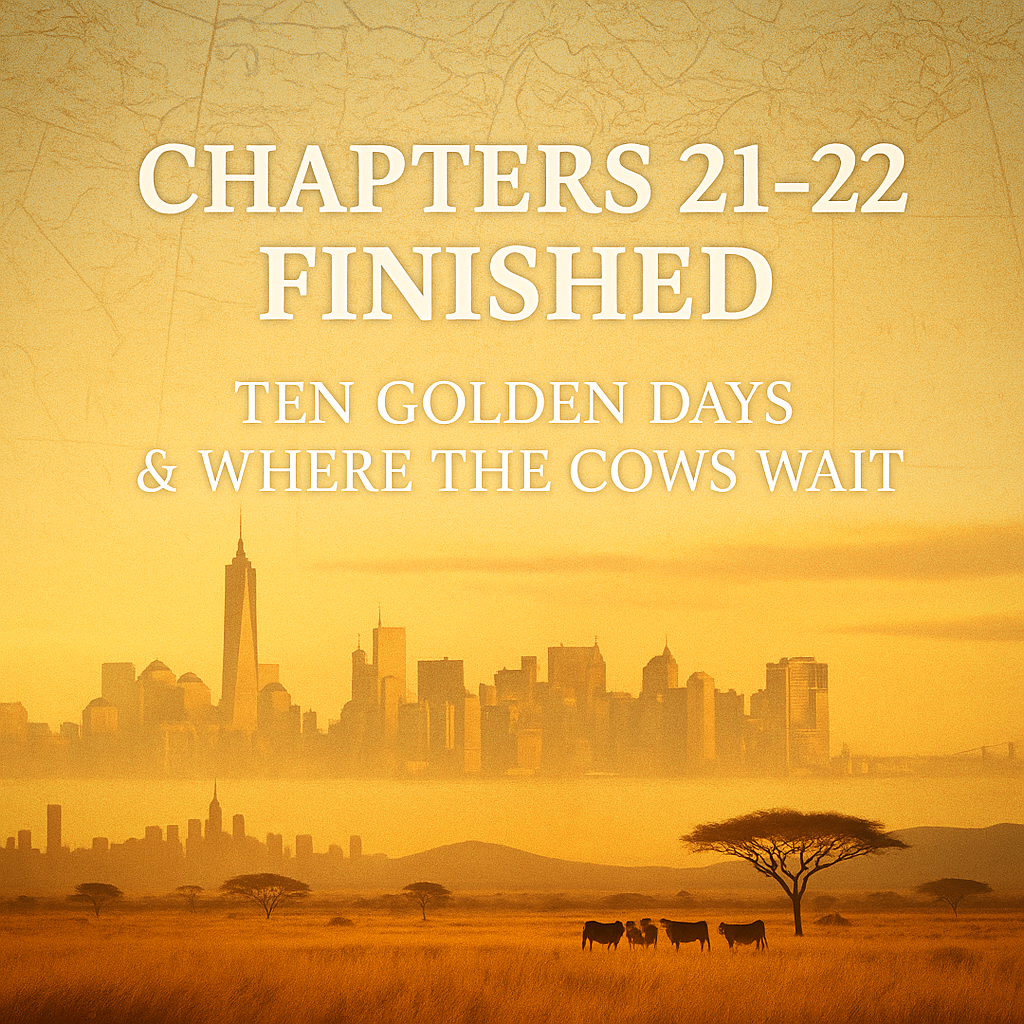
✨ Two New Chapters: “Ten Golden Days” & “Where the Cows Wait”
The journey continues. Two new chapters are complete — and with them, Kacper crosses another threshold in his long passage through war, work, and wonder.
Chapter 21 – Ten Golden Days
This chapter moves between two kinds of quiet: the strange hush of New York debrief days after Angola, and the tender stillness of a pilgrimage to Przemyśl with Mama. It sits in the tension between glass towers and cemetery pines, between lavender sheets in Lower Manhattan and the remembered mud of Bentiu — a week that lets Kacper feel both the distance from the field and the thread that still binds him to it.
In New York, he arrives bone-tired, slips into a small guest house in Lower Manhattan run by Peter and John, and discovers how comfort can sharpen memory: the softness of linens pulling Bentiu back into the room — swamp reeds, gunfire, sacks of sorghum intruding on blue walls and polished floors. The city glitters; his body refuses to forget. On Sunday, a grace note — a reunion with Magda and Ania from Nowy Sącz. They wander Times Square, drift into the hush of Central Park, tuck into a riverside walk along the Hudson; friendship steadies the day.
Then home to Nowy Sącz — and a drive east with his mother to Przemyśl, to look for Aunt Rozalia’s grave. The town greets them with San River light and old Galician façades. At the cemetery, time folds: pines, oaks, linden, birch; damp leaves underfoot; angels with broken wings; Cyrillic and Latin scripts side by side. Hours pass before they find the simple mound marked Grób Sióstr Świętej Felicyty — Sr. Rozalia. They stand a long while without speaking; grief and gratitude share the air.
A few brief excerpts
“The contrast itself seemed to be the essence of his life — Manhattan and Bentiu, lavender and swamp reeds, soft linen and dust.”
“Sunday unfolded with a brightness he had not expected… They showed him their hidden corners too — a bookshop folded between glass towers, a café with worn wooden tables, the riverside walk along the Hudson where the roar of traffic softened into the rhythm of water.”
“The cemetery gates stood tall and unhurried… It was still green — impossibly green… Catholic and Orthodox markers stood side by side — Latin and Cyrillic script entwined like old neighbours in quiet conversation.”
“Set apart from the more elaborate monuments… a simple iron cross… a small wooden plaque, lovingly carved: Grób Sióstr Świętej Felicyty — Sr. Rozalia.”
📷 Related photo albums for Chapter 21:
• Album 1 – Meeting in Sitges, Spain
• Album 2 – Visiting Przemysl, Poland
Chapter 22 – Where the Cows Wait
The flight south brings him to Nairobi, 2005. A new posting, a new continent’s rhythm. The war in Sudan has paused — but peace itself feels fragile, tentative, “a promise whispered more than shouted.” The city hums, half-hopeful, half-tired.
He meets Martin, the cautious programme manager whose kindness hides behind slow words, and Ruth, the logistician whose laughter never burns out. They will become his compass in the months to come. But first comes Lokichoggio, and then the north — the borderlands where planes land on airstrips of baked clay and the line between safety and need is drawn in dust.
“Southern Sudan was no longer at war, but neither was it yet healed. The land itself had not caught its breath.”
What follows is one of the book’s most haunting journeys — to Old Fangak, a village half-drowned by swamps and memory. Here, Kacper learns what endurance looks like without spectacle. Hunger and faith coexist, silence speaks louder than policy, and even peace smells faintly of smoke.
“He began to see what hunger meant — not statistically, but bodily, intimately. Poverty was grief, was infection, was silence after the last breath.”
And then, the discovery that gives the chapter its name: the cows. Sacred, sung, guarded by boys barely older than children. They are wealth, diary, ancestor, and song — the living heart of the Nuer world.
“Cows were not animals here. They were spirit and wealth and prayer. They were diaries and dowries, ancestors and heirs.”
Through them, Kacper grasps a truth larger than aid or ambition — that dignity and survival are not gifts to be given but languages to be learned. The final pages breathe with stillness and reverence:
“Sometimes he thought of the imbalance — of children lying hungry while cattle were led to higher ground. It felt cruel. But then, when he looked closer, it was almost holy — a covenant written in mud and milk.”
When he finally leaves, Ama folds laundry in silence — a quiet goodbye heavier than words.
“Fangak had entered like water through cracked earth — slow, steady, impossible to remove.”
Back in Nairobi, he realises he is no longer the man who arrived. Something in him has softened, widened, learned to wait.
Between Glory and Quiet
These two chapters mark a turning point. Kacper steps out of survival and into responsibility — no longer just the witness, but the one who must decide, lead, and sometimes fail. The tone of the memoir matures with him: the writing grows slower, more spacious, haunted by the awareness that every victory is partial, every lesson incomplete.
From the frozen light of Manhattan to the humid dawns of the Upper Nile, Memoir of a Wandering Spirit continues to map not only the world’s crises but also the small, stubborn sanctuaries that endure within them — friendship, faith, humility, and the grace of work done with open eyes.
“He knew this was just the beginning.”

Memoir of a Wandering Spirit
This space is where I’ll share the evolution of a story that has lived inside me for decades — a story of movement, memory, and the quiet weight of becoming. It’s a personal account, yes, but also a collective one — shaped by places, by people, by moments of wonder and fracture.
The memoir weaves through my early life in Poland, years in hospitals and schools that tried to contain me, and the unfolding path that led to war zones, refugee camps, and faraway friendships. From Biegonice to Zakopane, from Kerala to Caracas, from Nowy Sącz to Óbidos — this is a map made of scars and stars.
Here, you’ll find:
• Progress updates on the chapters as I write them
• Extracts from the manuscript
• Stories behind the stories — moments that didn’t make it into the book but still matter
• Photographs from the journey, both literal and emotional
• Occasional reflections on writing, remembering, and telling the truth with care
If you've shared a moment with me along the way — in Poland, Portugal, in the field, in a shelter, on a dusty road — you may find echoes of yourself here, in fictionalised form. Please know that every inclusion is crafted with respect and gratitude.
Thank you for being here.
Thank you for reading.
November 2025
October 2025
September 2025
August 2025
July 2025