Chapter 26: Of Ruins and Repairs
Chapter 26 is finally ready!
It takes place in Aceh, Indonesia — a region still marked by the devastating impact of the 2004 tsunami. What begins as a professional deployment quickly becomes something far more complex: a lesson in leadership, trust, and the slow, often uncomfortable nature of recovery.
When Kacper arrives, the project he is asked to lead is already struggling. Delays have accumulated, promises have not been met, and relationships with communities have deteriorated to the point where staff are hesitant to even return to the field.
“Donors were furious. Communities were losing patience. Promises had been made and broken.”
What appears at first glance to be a problem of performance reveals itself, over time, to be something deeper: a system paralysed by pressure, miscommunication, and loss of confidence.
Rather than imposing quick solutions, Kacper begins by listening.
“I’m here to understand.”
To his team.
To communities.
To the silences between what is said and what is avoided.
Slowly, a different approach emerges — one based on honesty, shared responsibility, and a willingness to accept limitations rather than promise what cannot be delivered.
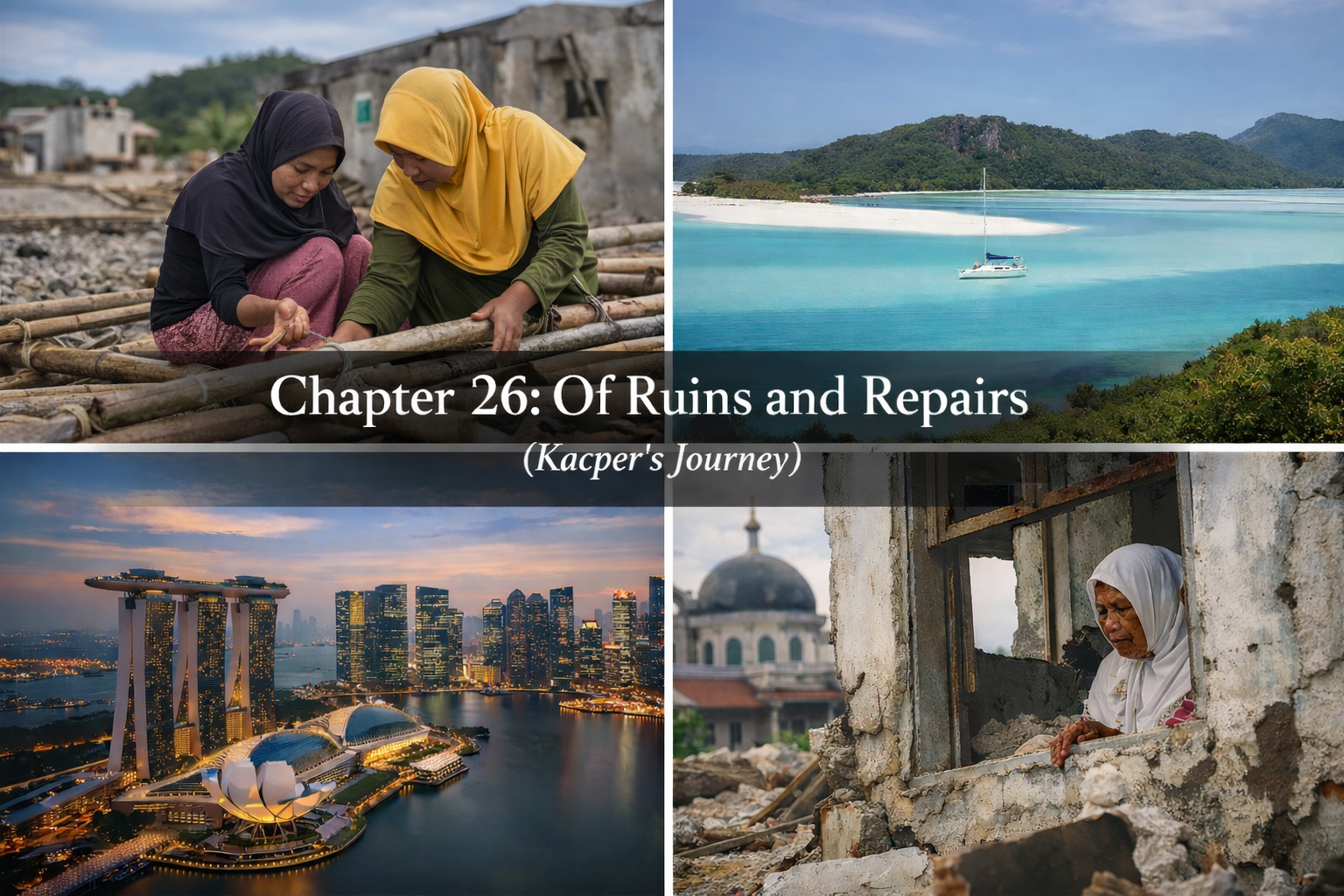
This part of the story is very close to my real experience. The photographs below come directly from that period, when I was working in Aceh and travelling across the region:
👉 https://photos.app.goo.gl/3bbgAyMGsRxcrZm1A
(Pictures from Aceh and other parts of Indonesia during the mission)
These images offer a glimpse of the landscapes, people, and daily realities that shaped this chapter — far beyond what words alone can capture.
At the heart of the chapter are the people Kacper meets. Colleagues who carry their own stories, strengths, and vulnerabilities.
Among them, Rizal’s journey stands out — a young Acehnese colleague navigating personal identity in a context where being himself carries real risks.
“For the first time… I think I am not afraid.”
His story becomes one of quiet courage and transformation, supported by the solidarity of those around him.
Aceh itself reveals a series of contrasts. Deep generosity and warmth coexist with strict social norms and the application of Sharia law. It is a place where kindness and constraint exist side by side, and where understanding requires patience rather than judgement.
The chapter then opens outward, following Kacper beyond Indonesia.
During this time, travel became not only a logistical necessity, but also a space for reflection.
A short stop in Kuala Lumpur:
👉 https://photos.app.goo.gl/FHq767PKCgxe41mQ9
(A day in Kuala Lumpur on the way to London)
Moments in Singapore:
👉 https://photos.app.goo.gl/cXapLHZuwRwtaJm57
(Singapore, on the way to Australia)
In Singapore, Kacper reflects on something that stays with him:
“A city that became a country. A country that behaved like a carefully run city.”
These journeys offered contrast — between order and chaos, between different forms of development, and between the many ways societies organise themselves.
The narrative then moves further, into Australia — a place that had long existed in Kacper’s imagination.
👉 https://photos.app.goo.gl/s4gALe21PNMNUEbq6
(Queensland: Brisbane and the Whitsundays)
This part of the chapter carries a different energy. Friendship, rest, openness. Time spent with people who had once shared difficult humanitarian contexts, now building a different kind of life.
Yet even here, the story does not become simple. Encounters with inequality — particularly affecting Aboriginal communities — serve as a reminder that no society is free from injustice.
“Prosperity rarely erased history.”
The balance is broken when Kacper receives news that his mother has been hospitalised.
The story shifts again.
From professional responsibility to personal fear.
From distance to urgency.
Waiting becomes its own kind of test.
“Waiting. It sounded simple. It never was.”
The return home to Poland becomes a moment of grounding — a reminder of what truly matters, and how fragile everything can be.
Back in Aceh, the final days are marked not by closure, but by continuity.
The project is not “fixed.”
But it is no longer broken in the same way.
The team has regained confidence.
Relationships have been restored.
Something has shifted.
The farewell is not formal. It is human. A gathering organised by the team, where a traditional Saman dance — precise, rhythmic, collective — becomes a powerful symbol of what has been rebuilt.
“This, he thought, is what we tried to do.”
Trust.
Coordination.
Shared purpose.
“Of Ruins and Repairs” is not a story about success.
It is a story about presence.
“Recovery… was not about fixing what was broken. It was about staying present long enough for repair to become possible.”
About staying long enough. Listening carefully enough. Trusting enough for something new to begin to emerge from what once seemed irreparably broken.
And perhaps most importantly — it is a reminder that repair is never complete.
“It would continue, carried by others.”
A note
All the photo albums linked above are from my own life during the time that inspired this chapter.
While the book follows Kacper, these images reflect the real places, journeys, and moments that shaped his story.

Memoir of a Wandering Spirit
This space is where I’ll share the evolution of a story that has lived inside me for decades — a story of movement, memory, and the quiet weight of becoming. It’s a personal account, yes, but also a collective one — shaped by places, by people, by moments of wonder and fracture.
The memoir weaves through my early life in Poland, years in hospitals and schools that tried to contain me, and the unfolding path that led to war zones, refugee camps, and faraway friendships. From Biegonice to Zakopane, from Kerala to Caracas, from Nowy Sącz to Óbidos — this is a map made of scars and stars.
Here, you’ll find:
• Progress updates on the chapters as I write them
• Extracts from the manuscript
• Stories behind the stories — moments that didn’t make it into the book but still matter
• Photographs from the journey, both literal and emotional
• Occasional reflections on writing, remembering, and telling the truth with care
If you've shared a moment with me along the way — in Poland, Portugal, in the field, in a shelter, on a dusty road — you may find echoes of yourself here, in fictionalised form. Please know that every inclusion is crafted with respect and gratitude.
Thank you for being here.
Thank you for reading.
November 2025
October 2025
September 2025
August 2025
July 2025