Two Weeks Until Departure
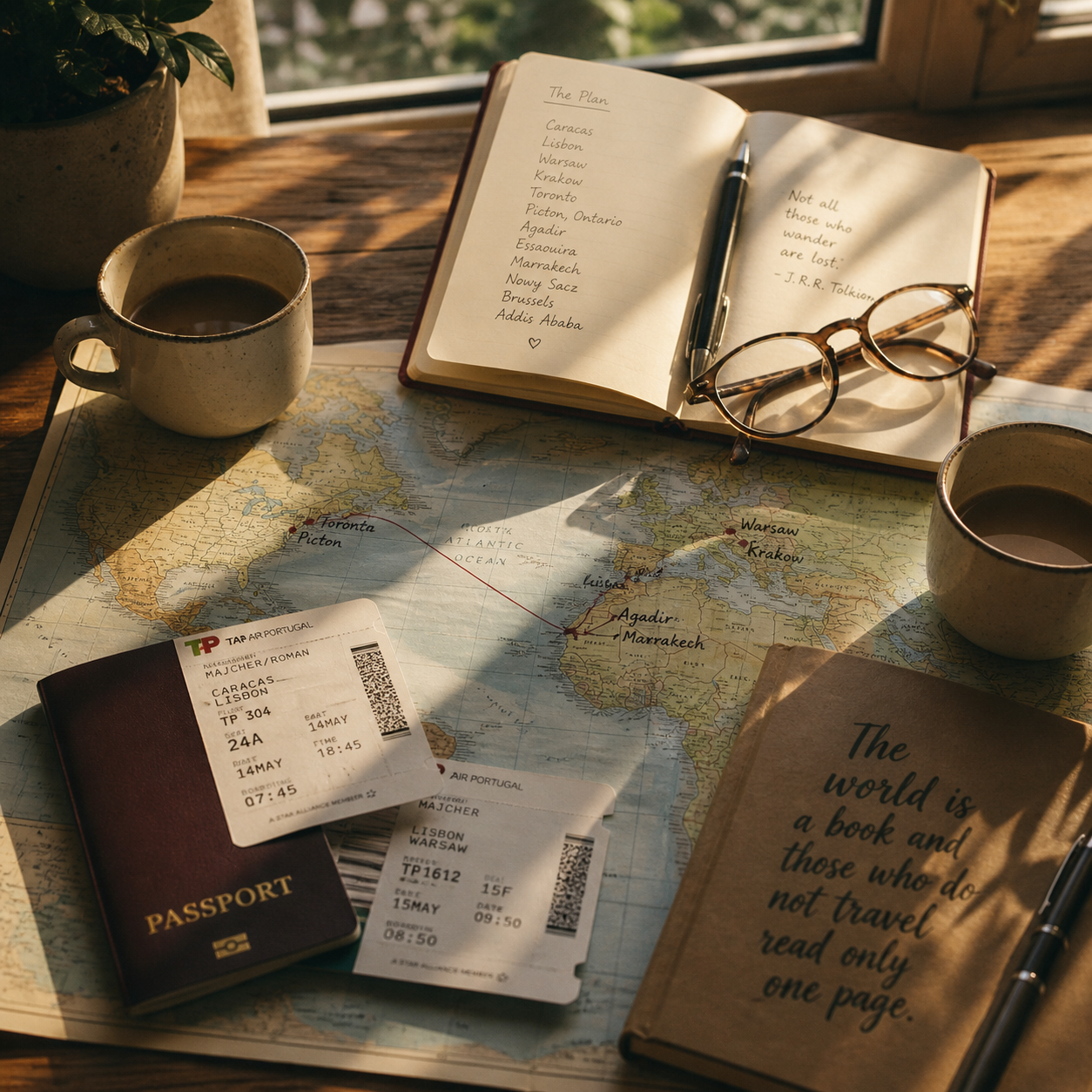
Preparing for the travel, Caracas, Venezuela, May 2026
It suddenly feels very close now.
Only two weeks remain until I leave Caracas for what will become a long sequence of journeys, reunions, transitions, airports, oceans, and roads. The tickets are booked, plans are slowly becoming real, and somewhere between excitement and logistics, I find myself already mentally moving between continents.
The journey will begin, appropriately enough, with one of those long TAP flights that seem to stitch my life together these days. From Caracas to Lisbon, then onward to Warsaw, and finally down to Kraków. I already know that familiar feeling of arriving slightly disoriented into the cool European morning light after crossing the Atlantic overnight.
And then — home.
I will spend two nights with Mum before we continue together toward Canada. From Kraków to Warsaw, and from there to Toronto. I am genuinely happy that we will be making this journey together. There is something deeply comforting in shared travel — small conversations at airports, coffee before boarding, the quiet companionship of moving through unfamiliar places side by side.
From Toronto, the plan is to drive with Tahir, Amna, and little Hania toward Picton, in Ontario. I have been looking at photographs of the area already: lakeside landscapes, small towns, open skies, vineyards, wooden piers stretching into calm water. Somewhere quieter. Somewhere where mornings begin slowly.
We will stay there for around a week, away from big cities, sharing time together, exploring the countryside, and likely making small trips around the region — perhaps toward Ottawa too. What I look forward to most is not any particular attraction, but the atmosphere itself: long breakfasts, evening conversations, nature, roads without hurry, finally meeting Hania in person, and seeing Tahir and Amna in this new chapter of their lives.
Then back again — Toronto to Warsaw — only briefly stopping before another journey begins.
This time southward.
Our first trip to Morocco.
We will fly to Agadir as part of an organised tour, which feels slightly unusual for me after so many independently improvised journeys across the years. But perhaps this is part of the charm too: letting someone else take care of the structure for once.
I already imagine the Atlantic coast, warm evening air, the colours of markets, the movement of people in the streets. We hope not only to stay in Agadir, but also to discover more of the country — the coast toward Essaouira, perhaps Marrakech, maybe smaller places along the way where life unfolds more quietly. Morocco has lived in my imagination for years as a meeting point of continents, colours, histories, and rhythms.
I think Mum is excited too.
After Morocco, we return to Poland again, and I will spend some quieter time in Nowy Sącz before another movement begins — Brussels for a week of meetings and preparation related to Addis Ababa. The next chapter slowly becoming real.
And then, eventually, back to Caracas once more. Back through Lisbon. Back to the familiar mountains surrounding the city. Back for the final stretch before Ethiopia.
I would be lying if I said I was entirely calm about all the flights. The ongoing aviation fuel situation and reports of possible disruptions across Europe have created a certain background anxiety around travel plans. Airlines and authorities insist that, for now, operations remain stable, although the wider situation continues to be monitored closely.
And yet, somehow, I remain hopeful that things will work out.
Travel always carries uncertainty. Flights get delayed. Plans shift. Connections are missed. One adapts. Perhaps years of humanitarian work have taught me that movement rarely unfolds exactly as imagined — and that flexibility matters more than control.
What stays constant is the anticipation.
The thought of seeing family and friends. Of discovering new places with Mum. Of coastlines and long roads and unfamiliar cafés. Of conversations unfolding somewhere between Toronto, Picton, Agadir, Marrakech, Warsaw, Lisbon, Brussels, and Caracas.
Life feels very much in motion these days.
And despite the uncertainties, I find myself grateful for that.
Happy Easter to Everyone Celebrating
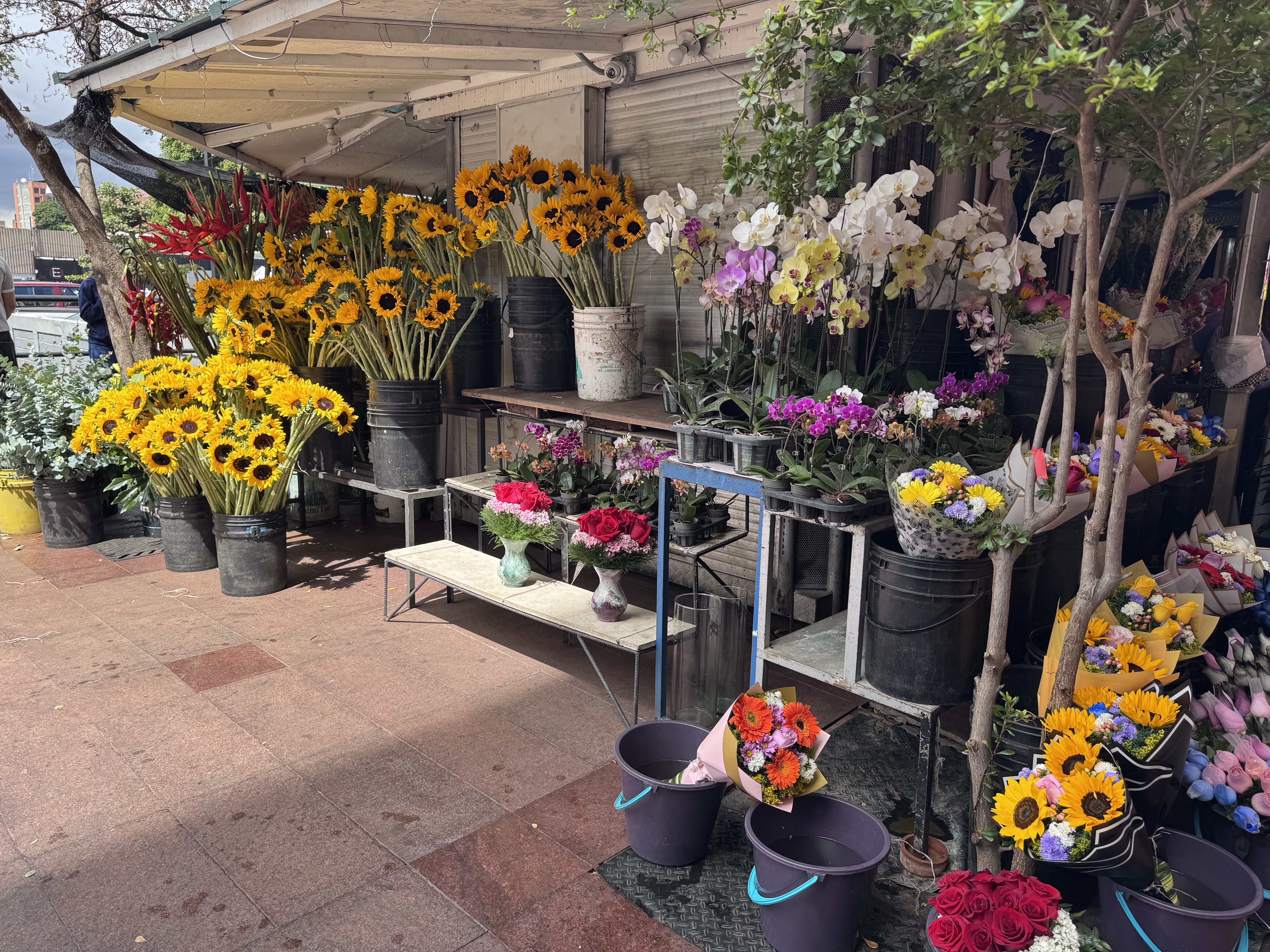
A Flower Stand, Caracas, Venezuela, January 2026
Spring, movement, and a few thoughts from Caracas 🌿
Dear friends,
Spring seems to be arriving quietly again, almost without asking for attention. A shift in the light, in the air, in the way one begins to think a little further ahead. It feels like one of those moments in the year when things do not change suddenly, but gently begin to move.
I am writing this from Caracas, having just returned from a week in Apure. It was one of those trips that leaves you both tired and strangely grounded. Long days in the field, conversations that stay with you, and the reminder of how complex and fragile the reality here continues to be. And then, coming back — to a desk, to emails, to a different rhythm — with a sense that both worlds somehow coexist, even if uneasily.
There is also a quiet awareness that my time in Venezuela is slowly coming to an end. It does not feel dramatic, but rather like the closing of a chapter that has been intense, demanding, and, in many ways, deeply formative. What will stay with me most are the people. Over time, this place stopped being just a duty station and became something more human, more personal. I have been incredibly lucky to find here not just colleagues, but a kind of family — Mayling, Giovanni, and Samantha, who have been a constant source of warmth and kindness in these years.
There have also been moments of relief and gratitude recently. We have just learned that Leo’s work permit in Spain has been extended for another year. It is difficult to put into words what this means, but it brings a sense of stability and hope that was very much needed. I feel deeply grateful to all of you who, in one way or another, were part of the support around him.
Looking ahead, a new chapter is slowly taking shape. As of August, I will be moving to Addis Ababa with ECHO. It still feels a little abstract — more a direction than a reality — but I am looking forward to discovering what this next step will bring.
Before that, the coming months will be filled with movement. In May and June, I will be spending time in Europe, including Poland, and I am especially happy that I will be travelling together with my Mum. From there, we will go to Canada to visit Tahir, Amna, and their daughter Hania — whom I have not yet met in person. I find myself looking forward to that moment with a kind of simple joy.
There will be other stops along the way — a bit of travel, a bit of transition — but perhaps what I am most aware of is the passage itself. Moving between places, between roles, between phases of life, and somehow trying to remain connected to the people who matter, even as geography keeps shifting.
I often think of how our lives have spread across continents, and how, despite that, certain connections remain steady and quietly present. This message is, in a way, also just that — a small bridge across distance.
I hope that wherever you are, this season brings you some space to breathe, to rest, and to look ahead with a sense of calm.
Sending you my warmest thoughts,
Roman
Back to the Field
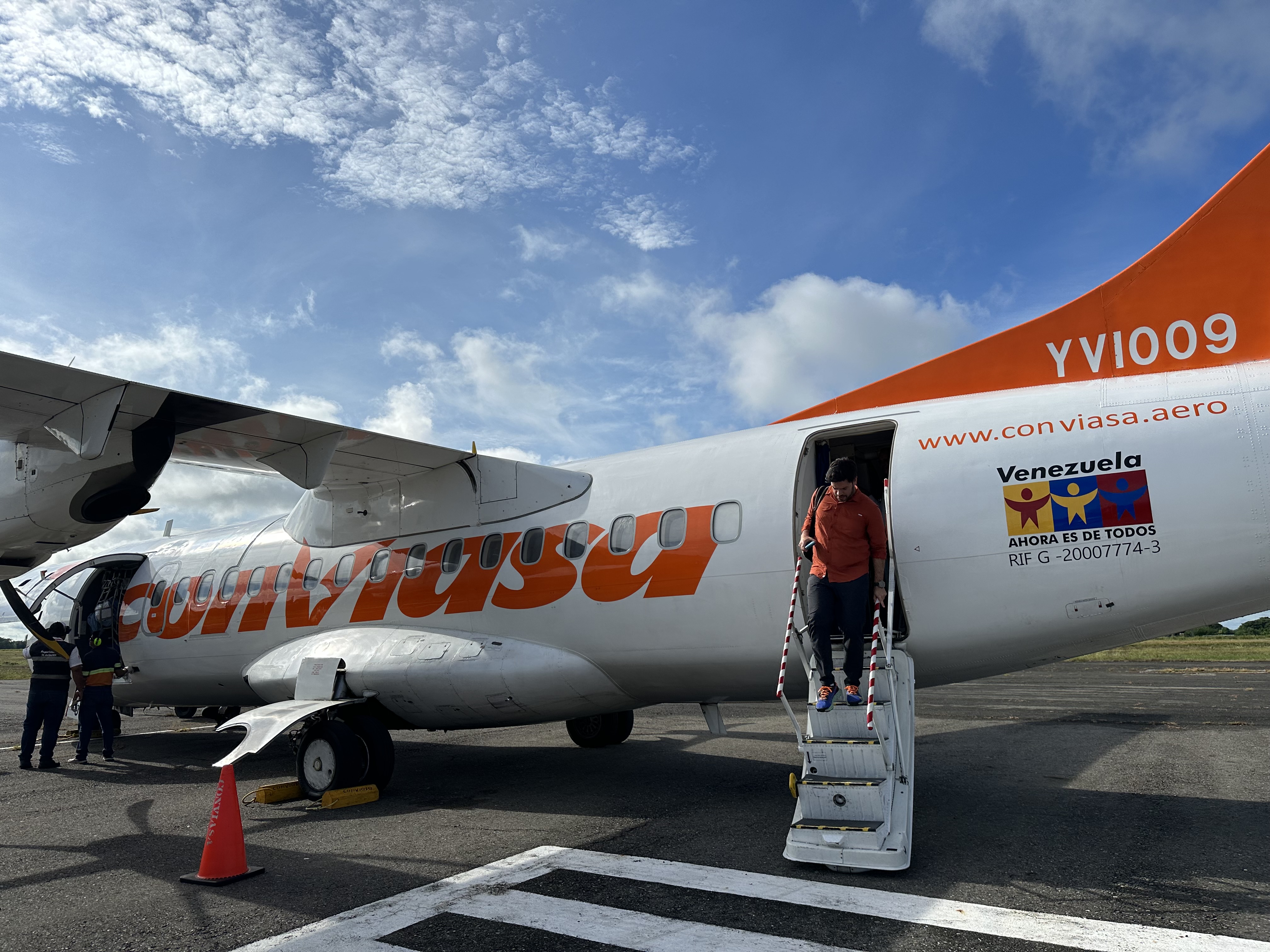
Travelling in Venezuela, Camaguan, Venezuela, October 2023
Soon, I will travel again within Venezuela.
There is something about field visits that stirs a particular kind of anticipation — not the excitement of airports or distant horizons, but something deeper and steadier. A return to the ground. To the dust. To the schools and clinics and community halls where plans on paper take tangible form.
In a few days, I will head south, leaving Caracas early in the morning and travelling by road for many hours until the landscape opens into the vast plains of Apure. Long stretches of highway, two brief stops along the way, and then arrival in San Fernando. These journeys are never merely logistical; they are transitions. They allow the mind to slow, to shift from office conversations to the rhythm of communities.
The purpose of the visit is simple, yet essential: to see, to listen, to better understand how the activities we support unfold in practice. Meetings with local authorities, conversations with teachers and health staff, exchanges with community representatives — all part of ensuring that what we fund truly reaches those it is meant to serve.
One of the moments I most look forward to is visiting a school that, not long ago, stood empty. No students. No functioning facilities. Now its doors are open again. Classrooms that were silent hold voices once more. Desks and materials have been delivered. Teachers have received training. Water access has improved through the drilling of a well and installation of storage systems. Solar panels have been installed. Even school gardens are being cultivated — small but meaningful signs of continuity and dignity returning to daily life.
There will also be visits to protective spaces within schools — places designed not only for learning, but for safety and expression. Musical instruments, traditional clothing, educational materials — modest details perhaps, yet in communities that have faced isolation and hardship, such elements matter. They signal normality. They signal investment in the future.
In another community, discussions with local health authorities will focus on the broader situation — the pressures on services, the gaps that remain, the realities behind the statistics. These conversations are rarely dramatic. They are practical. Honest. At times sobering. But always necessary.
Field visits are not glamorous. They involve long drives, early breakfasts, dust on shoes, notebooks filled with observations. Feedback sessions in modest offices. Returning late in the afternoon, tired yet clearer about what works and what still needs attention.
And yet, these moments reconnect me most strongly with why this work matters.
Walking through classrooms, listening to teachers, speaking with community members, observing how infrastructure improvements translate into daily routine — this is where abstraction gives way to reality. Questions are asked. Notes are taken. Assumptions are tested against lived experience.
There is something profoundly grounding about standing where support becomes visible — where children sit at desks that were not there before, where water flows where it once did not, where attendance grows from zero to dozens within a year.
As my time in Venezuela gradually moves toward its final months, these visits carry a particular weight. They are not only moments of monitoring and evaluation, but of witnessing — of standing still long enough to understand what has changed, and what still requires patience.
The road south awaits.
The plains of Apure stretch wide and quiet.
In places like these, impact does not announce itself loudly. It appears in small, persistent shifts — a reopened classroom, a functioning water point, a teacher who stays, a student who returns.
This is where the abstract becomes real.
Where distance narrows.
Where purpose settles back into focus.
And perhaps that is why going back to the field always feels less like departure, and more like return.
When Access Narrows
Humanitarian Food Drops, Juba, South Sudan, July 2014
Over the past days, the headlines from the Middle East have become heavier again.
Missiles. Retaliation. Escalation. New fronts opening. Borders tightening. Civilian casualties rising in Iran, Israel, Lebanon, Gaza. Words repeat themselves with disturbing familiarity, even as the geography expands.
As someone working in humanitarian response, I read these updates differently. Behind every headline I see not strategy, but people. Families who did not choose the timing of this escalation. Children who do not understand why sirens dictate their sleep. Elderly people who must once again decide what to carry and what to leave behind.
Civilians always pay first. And they pay longest.
What worries me deeply is how quickly humanitarian space begins to shrink when escalation accelerates. Border crossings close. Access routes become unsafe. Aid convoys are delayed. Communication lines collapse. What yesterday was difficult becomes nearly impossible today. And in that shrinking space, food deliveries stall, medical supplies run low, water systems fail, protection mechanisms weaken.
Humanitarian action depends on fragile conditions: access, dialogue, minimal security guarantees, respect for international humanitarian law. These conditions are rarely robust. They are negotiated, delicate, constantly tested. When military logic dominates, humanitarian logic struggles to breathe.
Diplomacy, too, becomes fragile. In moments of rapid escalation, trust erodes quickly, and once lost, it is not easily rebuilt. The space for quiet conversations — the kind that prevent further suffering — narrows. Yet it is precisely in these moments that such conversations matter most.
From Caracas, geographically far yet professionally close, I feel the weight of this familiar cycle. The Middle East does not experience crisis in isolation; instability echoes across regions, affecting economies, displacement patterns, political tensions far beyond immediate borders.
But at the centre of it all are not geopolitical calculations.
At the centre are people waiting for crossings to reopen. Patients hoping electricity will hold in hospitals. Parents trying to create normality in abnormal days. Aid workers attempting to operate in environments where security assurances shift by the hour.
This is not a political reflection. It is a human one.
Escalation always feels sudden. Human consequences are never sudden. They accumulate quietly, day after day, long after media attention shifts elsewhere.
In times like this, I find myself returning to something simple: the reminder that humanitarian space must be defended not as a political position, but as a human necessity. Civilians deserve protection. Aid must reach those who need it. Dialogue must remain possible.
These are fragile principles.
But they are not optional ones.
Not Ready to Say Goodbye

Changes are coming!
Exciting times, and time moving too fast
Some additional developments have taken place over the past days.
Following further clarifications from headquarters regarding policies and timelines linked to my transfer from Venezuela to Ethiopia, I have finally been able to adjust both my professional and personal movement plans for the coming months. For a while, everything felt slightly suspended, dependent on decisions still taking shape somewhere between offices and calendars. Now things have become clearer, and with clarity comes a certain calm.
All in all, it seems that I will remain here in Caracas until mid-May.
I am genuinely happy about that. These remaining months offer time to close this chapter properly, not abruptly. I hope to use this period to undertake one or two field visits within Venezuela. Plans are still forming, but I am already looking forward to travelling inside the country again, visiting projects we support, seeing firsthand how ideas written in proposals translate into real support for people and communities. Those moments in the field always reconnect me with the essence of the work.
Then May and June will unfold very differently.
For several weeks I will be largely outside Venezuela, combining holidays with some professional commitments. The journey will begin in Poland, where I will travel to pick up Mum. From there, together, we will fly to Toronto for a long-awaited visit. Finally we will be able to spend time with Tahir and Amna and meet their daughter, Hania, whose arrival already feels like part of our extended story even before we have met her in person.
During our stay in Canada, the plan is beautifully simple: together with Tahir’s family we will rent a place somewhere in the countryside, either in Ontario or Québec, not too far from Ottawa. Somewhere quieter. Somewhere surrounded by nature. A smaller place from which we can make daily excursions, explore villages and landscapes, and visit friends nearby without the pressure of large cities. The idea of shared breakfasts, walks, conversations stretching into evenings, and unhurried days already feels like a gift.
From Canada we will return briefly to Poland — almost just to change planes in Warsaw — before continuing south once again, this time to Agadir.
It will be our first journey to Morocco, and both Mum and I are genuinely excited. Although we will spend a week by the ocean, the plan is far from staying still. We want to explore Agadir itself, travel to Marrakesh, and venture into the southern landscapes — perhaps along the Atlantic coast, into small fishing villages, desert-edge scenery, and the mountains that shape that part of the country. A different continent, different colours, different rhythms.
After Morocco, we return once more to Poland. I will spend some time in Nowy Sącz, working a little, slowing down, and simply enjoying being home. Then, in mid-June, I will travel to Brussels for meetings and preparatory training that will allow a smoother transition into my future responsibilities in Addis Ababa.
From Brussels, I will return again to Venezuela for several final weeks — preparing both myself and the office for the transition ahead. Somewhere in mid-July I will travel back to Poland to take my obligatory respite leave before the next chapter begins.
And then, almost suddenly, it will be time to move to Ethiopia, with arrival planned for 1 August.
It all feels exciting. Full of movement and anticipation.
And yet, beneath that excitement sits another feeling too: time seems to be running incredibly fast. The calendar advances with a certainty that emotions rarely match. I realise more and more that I am not entirely ready to say goodbye to Venezuela. This country, and Caracas in particular, have become deeply meaningful chapters of my life — professionally demanding, personally rich, and filled with friendships that will remain long after departure.
So for now, I choose to stay present in what remains.
There are still months here. Still conversations to have, places to revisit, work to complete, journeys inside Venezuela yet to happen. And hopefully, along the way, opportunities to see many of you — somewhere between Caracas, Poland, Canada, Morocco, Brussels, or beyond.
The road ahead is already visible.
But this chapter is not finished yet.
Letting the Days Settle

Back to the Country: Chacao, Caracas, Venezuela, February 2026
More than a week has passed since I returned to Caracas.
Already it feels as though my wonderful journey through Lima, Montevideo, Colonia del Sacramento, and Panama happened long ago — like a chapter I finished reading and then slowly carried in my pocket. Yet whenever I open the photo galleries from that trip, I am again carried away by memory: the light on the ocean cliffs in Lima, the slow river light in Montevideo, the cobblestone curves of Colonia at dusk, and the familiar streets of Panama that seemed to welcome me back with quiet warmth.
🇵🇦 Panama
Even a brief stay there felt like returning to an old conversation. Casco Viejo’s pastel façades, balconies that lean gently into time, and the soft, forgiving quality of light at dusk made me feel seen by the city rather than merely passing through. Walking Avenida Balboa and letting the Pacific stretch its vast calm before me felt like inhaling deeply — the way you breathe when you first wake and realise you slept soundly.
Panama photos: https://photos.app.goo.gl/C3MkWdfQmuFyHjwE8.
🇵🇪 Lima
Three days in Lima taught me how a city can unfold slowly if you are willing to walk with no destination in mind. In Miraflores, mornings began quietly, tree-lined streets filtering sunlight and cafés waking with gentle rhythm. Then the land dropped away to the Pacific below — a presence more than a view — and I stood for longer than I expected, watching waves shape themselves into patterns of calm repetition. Barranco felt like a place that remembers its own stories, each narrow street and balcony whispering histories I was only beginning to hear.
Lima photos: https://photos.app.goo.gl/FwN4vSnLzoZcEXSp9.
🇺🇾 Montevideo and Colonia del Sacramento
Montevideo was a slow unfolding, like finding your footing inside a different kind of quiet. The rambla along the river that stretches and pretends to be an ocean welcomed me with its open pace — walkers, mate flasks, dogs, light shifting slowly across water. Guided strolls through Ciudad Vieja and markets where voices rise and settle made me appreciate how ordinary life, lived generously, shapes a city’s heart. And Colonia del Sacramento, with its timeless cobblestones and warm dusk light, felt like stepping into a memory I hadn’t yet lived but somehow recognised.
Uruguay photos: https://photos.app.goo.gl/2S2KjPqdSWTcDp6W6
It was a solo trip — not out of solitude, but out of that rare, quiet freedom that comes when you travel by yourself. I like travelling with people, and I treasure shared explorations. But there is something about wandering new places alone — and returning to familiar ones in that way too — that makes you feel more fully engaged with your own thoughts, with the world as it moves around you, and with the subtle unfolding of your own self. It left me happy, refreshed, and invigorated — as though something inside me had been gently tuned before returning to the usual rhythms of life in Caracas.
And I am enjoying my time here a lot.
Caracas is not just a home base; it is home in the way certain cities quietly become part of you. I have wonderful friends here, and I appreciate every shared meal, every conversation that stretches long into the evening, every unexpected moment of laughter. Even when I get tired — and I do at times — there is a deep sense of belonging in this city that I am grateful for.
We are not entering a calm period at work — but the pace is different now. We are in the midst of allocating funds for our projects in 2026 and beyond — a huge amount of work that demands careful reading of proposals, thoughtful analysis, and difficult decisions about where our resources will make the best impact. It is challenging, dense work, and often not easy. Yet it is engaging in ways that make me feel grounded in purpose. This is a very interesting time — demanding, yes, but also rich with possibilities.
Even as some of these plans still seem distant, my thoughts turn gently toward what comes next.
I find myself thinking about my next deployment in Ethiopia — about moving to Addis Ababa, about how the city has changed since my last visit, about the rhythms of life there, and about the work that will unfold in that chapter. I have been reading, learning, preparing quietly in the background of each day. Already I have a feeling of how things may go, though of course the reality will have its own shape and pace. But before that chapter begins, there are still months here — hopefully with trips to the field across Venezuela, to see and evaluate our projects where they live, on the ground, with the people they touch.
Then in June, I will be heading to Brussels, and likely to Poland as well — another kind of return, another reconnection. And after that, there are provisional thoughts in my mind about what I may be doing with my mum and with friends before Ethiopia begins in earnest… but that is a story for another time, when the right moment arrives.
For now, I sit with these memories — letting the quiet of Panama linger a little longer in my bones, letting the images and sounds of strange and familiar streets unfold again in my mind, and letting the slow rhythm of life here in Caracas fold gently around me.
Recharged

Around my hotel, Panama City, Panama, February 2026
I am sitting in Panama again, in my hotel room where the city hums quietly below, thinking about these past two weeks. Tomorrow morning I will be flying back to Caracas, but today is still filled with small rhythms of work — a final visit to the office, a last coffee with colleagues, conversations that feel both familiar and slightly changed by absence.
This trip was exactly what I needed: a chance to recharge my batteries in a way only travel seems to allow. There was no stress, no strict plan — just openness and the willingness to let each place reveal itself at its own pace. It was a holiday born out of a subtle window of time between other responsibilities, and it turned out to be one of the most peaceful and refreshing breaks I’ve had in a long while.
Panama felt like an old friend from the first steps. One day there, but enough to walk Casco Viejo again, to let its layers of memory settle differently in my mind. Familiar streets, pastel façades, and that quiet sense of continuity — places that remembered me even before I remembered them. Panama always offers more than transit; it offers pause and recognition.
Lima followed with its own gentle lessons in attention. Three days of walking — not rushing, just letting the city’s rhythm meet my curiosity. Miraflores in early light, coffee in quiet cafés, then the sudden drop to the Pacific below the cliffs, waves rolling in their quiet discipline. In Barranco I wandered narrow streets where stories cling to balconies and walls, and I crossed the Bridge of Sighs almost by accident, a small ritual that felt bigger than it needed to be.
In Montevideo I found a different sort of calm — unhurried, gracious, rooted in ordinary life. I walked the rambla beside the wide river that feels almost like an ocean, passed people with mate flasks and dogs by their sides, and let the city’s softer rhythms unfold. One day brought light rain after bright sunshine, a small reminder that nothing stays the same from one moment to the next. With a guide, I visited key corners of the city and even began planning a visit to Colonia and perhaps further east to Costa del Este — places that now sit quietly on my list of “somewhere else.”
And through it all, I walked. Every day was measured not in flights or bus rides, but in steps — fifteen thousand most days, and once in Lima more than twenty-thousand. My legs felt it by the end of each evening, in that satisfying way that tells you you’ve truly seen a place with your own two feet.
Now, in this calm moment before departure, I realise how much this journey has refreshed me. There was no rush, no checklist, no pressure to perform curiosity — just a letting be, a going with the flow, and the simple joy of exploring. I needed that. And I am happy to be returning to Caracas tomorrow — not reluctantly, not tired, but full of stories, calm in my mind, and grateful for the days that helped me breathe a little more deeply.
More soon from home, and pictures will follow!
Walking South

Walking around the city, Montevideo, Uruguay, January 2026
After a few days of movement and discovery, I find myself in Montevideo.
The journey unfolded gently. One day in Panama City, just enough to let memory walk beside me again. Three days in Lima, where the city revealed itself step by step, patiently, through walking rather than explanation. And now Uruguay, arriving not with spectacle but with a quieter promise.
Panama was brief, but full.
Returning there always feels layered. Casco Viejo held me again in its narrow streets and softened façades, shaped by centuries of destruction and reinvention. I walked past places where earlier versions of my life unfolded — cafés where mornings once stretched lazily, streets whose rhythm I still carry in my body. Panama never feels like a stopover. It feels like a place that remembers, even if the remembering happens mostly inside me.
Beyond the old quarter, the city opened outward. Avenida Balboa, where the skyline meets the Pacific and ships wait patiently offshore. Vía Argentina, alive with conversation and shade. And Ciudad del Saber, where ideas once mattered more than speed, where I worked, worried, hoped, and believed deeply in cooperation. Being there again felt like opening an old notebook and recognising your own handwriting.
Then Lima.
Three days of walking until the city began to speak.
I arrived without a plan, which felt exactly right. Lima does not demand preparation; it asks for attention. Miraflores welcomed me with calm streets and filtered light, before suddenly giving way to the cliffs and the Pacific below. The ocean there is not decoration — it is presence. Constant, steady, indifferent.
Barranco followed, narrower and more introspective. A place that remembers. I crossed the Bridge of Sighs almost accidentally, held my breath, made a quiet wish, and smiled at myself for participating in a legend I had just learned. Cities endure not only through architecture, but through these small agreements to keep stories alive.
The second day deepened everything. With Sebastián, the historic centre opened its layers — the cathedral heavy with centuries, a discreet library behind the presidential palace where silence felt intentional, protective. Then Chinatown, alive and unapologetic, where fusion has long since become tradition rather than novelty. And later, fountains rising and dancing at dusk, joyful and slightly absurd, children running between jets of light. Lima does not resist contradiction. It embraces it.
The final day was deliberately simple. Shopping, coffee, familiar streets that had already begun to feel known. That moment when a place stops being new is always bittersweet. I packed slowly, knowing I was leaving unfinished conversations behind — with the city, and perhaps with myself.
Since leaving Caracas, I have been walking constantly. Fifteen thousand steps a day has become the norm, and one day in Lima reached just over twenty thousand. My legs feel it — but in the best way. Walking remains my favourite way of understanding a place. It aligns thought and movement, quietens noise, sharpens attention.
And now Montevideo.
Yesterday was bright and full of sun. Today it is raining lightly, and the change feels welcome. The city seems to soften under rain, colours deepening, sounds lowering. Later today I will meet a guide who will show me the highlights of the city — an introduction, a first conversation. Together we will also plan a visit to Colonia, and perhaps further east along the coast, to places where the map loosens and the rhythm changes.
I am looking forward to all of it.
Being here feels like the right pace. Not rushing, not accumulating, just moving attentively from one place to the next. Travelling like this — walking, listening, letting cities unfold rather than perform — reminds me why distance matters. Why change of place changes something inside us too.
More soon, from this side of the river that pretends to be an ocean.

April 2026
March 2026
February 2026
January 2026
December 2025
November 2025
October 2025
September 2025
August 2025
July 2025
June 2025
May 2025
April 2025
March 2025
February 2025
January 2025
December 2024
November 2024
October 2024
September 2024
August 2024
July 2024
June 2024
May 2024
April 2024
March 2024
February 2024
January 2024
December 2023
November 2023
October 2023
September 2023
August 2023
July 2023
June 2023
May 2023
April 2023
March 2023
February 2023
January 2023
December 2022
November 2022
October 2022
September 2022
August 2022
July 2022
June 2022
May 2022
April 2022
March 2022
February 2022
January 2022
December 2021
November 2021
October 2021
September 2021
August 2021
July 2021
June 2021
May 2021
April 2021
March 2021
February 2021
January 2021
December 2020
November 2020
October 2020
September 2020
August 2020
July 2020
June 2020
May 2020
April 2020
March 2020
February 2020
January 2020
December 2019
November 2019
October 2019
September 2019
August 2019
July 2019
June 2019
May 2019
April 2019
March 2019
February 2019
January 2019
December 2018
November 2018